 von
von 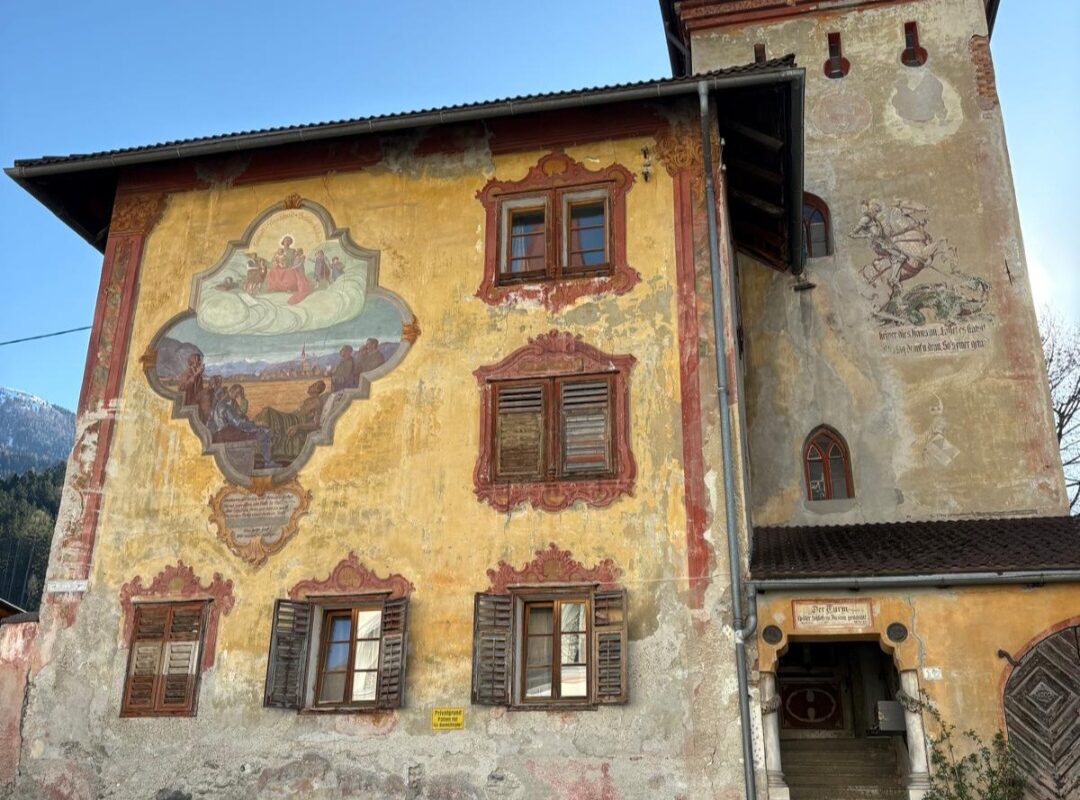
Tyrol 100 Years Ago
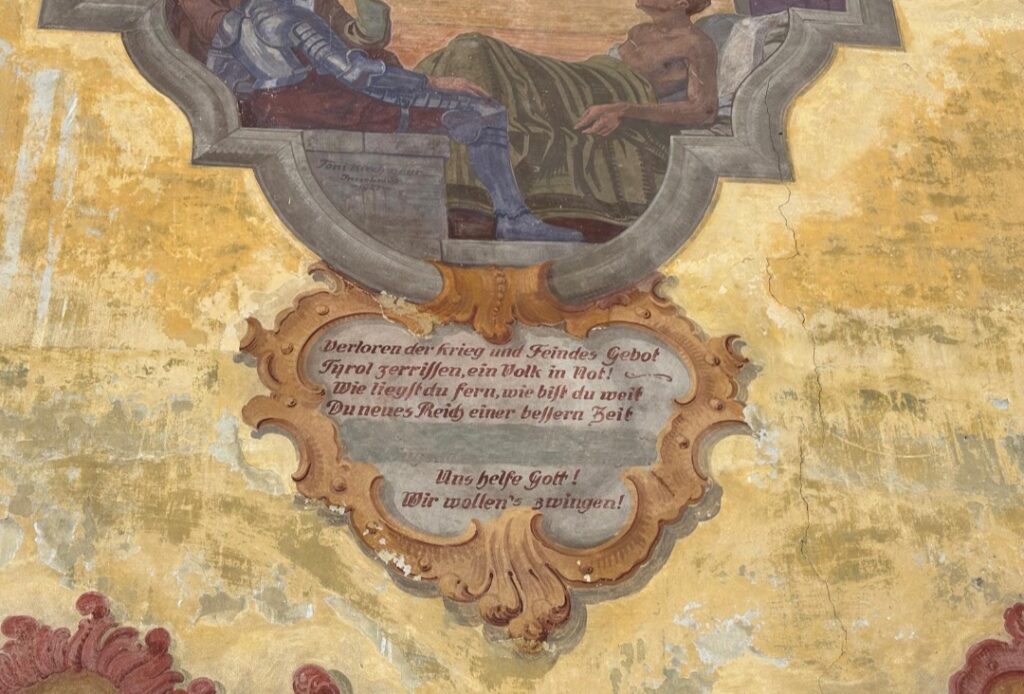
Verloren der Krieg und Feindes Gebot
Tyrol zerrissen, ein Volk in Not!
Wie liegst du fern, wie bist du weit
Du neues Reich einer bessern Zei
…………………?…………………
…………………?…………………
Uns helfe Gott!
Wir wollen’s zwingen!
On the heart-shaped mural plaque of ‘Der Turm’ in Inzing is embossed that strongly-worded text. The words clearly date from after 1919 when the Treaty of Versailles split the Tyrol. The 5th and 6th lines have been crudely erased. Why, one wonders? Some anti-Semitic reference, perhaps?
“In the Berg Isel Museum at Innsbruck, tucked away in a top-room to escape the vulgar gaze of tourists, hangs a heart-rending painting called Zerrissenes Tyrol – a youth sitting dejected upon a peak, clasping a wounded eagle with head bowed and trailing wings; the national colours on the ground with broken standard and – each side of the picture – black-crêped wreaths.
In almost every Tyrol cottage hangs a copy of that scene with words by their national poet Dr. Willram: ‘Zerrissen die Fahne, zerstückelt das Land / Die Heimat ein Opfer der Ochergen!/ Doch lodert die Freiheit in Sonnenbrand. / Auf unseren ewigen Bergen/ Bis klirrend der Knechtschaft Fessel reisst / Und der Adler sein alles Tirol umkreist.‘ ” (sic) (Owen Hamilton, Tyrolean Summer, 1934)
In the English translation of the 1928 book by Eduard Reut-Nicolussi (‘Tyrol Under the Axe of Italian Fascism’), we read in the Foreword to his book, in referring to the plight of those living in South Tyrol:
“Despite the oppression meted out to the Tyrolese, not a man among them in the last ten years of foreign domination has for an instant thought of surrendering the country. Belief in the Homeland – in the sense of a Tyrol one and undivided – is as it were a heritage of History, innate in the soul of a people.”
On a mighty tablet in a ceremony in Brixen, the words:
“We will never cede our thousand-year right / To Tyrol, our Homeland dear – / Have proved ourselves ‘gainst odds in fight,/ Ne’er looked on the face of Fear!”
How have English writers regarded Tyrol in the 1920s and early 1930s?
“I was last in Austria in the autumn of 1932: the growing agony brought about by the ambitions of a neighbour has changed smiles into tears….But that Austria will emerge from her troubles smiling once more is certain….It was not my intention to touch on politics because the Austrian people in ordinary times are too care-free to worry about them.” (Aimée Watt Smyth, Austria – ‘The Land of Smiles’ – and Tears, 1935)
“ ‘You understand’, the Heimwehr member persisted, still thinking I had come to spy out the land and anxious I should record correctly: ‘we Austrians do not want to be the slaves of Germany. That’s why we have formed our Heimwehr – to resist Hitler.” (Owen Hamilton, Tyrolean Summer, 1934)
“Again and again in Tyrol I heard expressions of admiration for Hitler and wistful references to the apparent prosperity and progress under his leadership of the German nation.” (Nina Murdoch, ‘Tyrolean June’, 1936)
From the darkening political situation of the early 1930s, let us turn to brighter views by English writers on the Tyrol:
“For the Tyrolese, the importance of Stams lies in the fact that it contains the bodies of so many rulers of the country, in the ‘Herzogsgruft’. Frederick with the Empty Pocket is here – so is Sigismund the Rich in Coin, with his wife, Eleanora Stuart, whom he brought from Scotland, and many other famous rulers. The parish church on the hill-side is pure rococo, but of poor quality.” (G.E.R. Gedye, ‘A Wayfarer in Austria’, 1928)
Which church could he be referring to, we wonder?
“Beauty and grandeur there are in full measure in Tyrol. It is a country for a wanderer. …..You taste (the essence) when the last steep slope of the pass is beneath you and the blue distances spring upwards to your vision.” (F.S. Smythe, Over Tyrolese Hills, 1936)
This almost romantic view of Tyrol as idyllic had been expressed earlier by D.H. Lawrence when he wrote from Mayrhofen to a friend, Sallie Hopkin, on August 19, 1912:
“Here we are lodging in a farmhouse. A mountain stream rushes by just outside. … We go quite long ways up the valleys. The peaks of the mountains are covered with eternal snow. Water comes falling from a fearful height, and the cows, in the summer meadows, tinkle their bells. …. I believe we could find the Edelweiss if we tried. Sometimes we drink with the mountain peasants in the Gasthaus, and dance little.”
From Sterzing on September 2, 1912, Lawrence wrote – less enthusiastically! – to his friend Arthur McLeod:
“I have walked here from Mayrhofen – quite an exciting scramble. And last night we slept in a hut 2000-some odd hundred metres high. It was damnably cold. The water was simply freezing. And I nearly got lost. Don’t be surprised if I do vanish some day in some oubliette (forgotten hole) or other among these mountains.”
After the War Lawrence returned briefly to Austria. On August 3, 1921, from the Villa Alpensee, Thumersbach, Zell-am-See, he wrote to Catherine Carswell:
“You can buy almost anything, with enough Krone. But the shops are empty – the land financially and commercially just ruined. There is very good white bread – but the food is monotonous. Still, you’d never know you were in a ruined land. The Austrians are as amiable as ever. Travelling is cheap, and quite easy, and the people honest and pleasant.”
From his novel Women in Love (1921):
“Innsbruck was wonderful, deep in snow, and evening. They drove in an open sledge over the snow: the train had been so hot and stifling. And the hotel, with the golden light glowing under the porch, seemed like a home. …. ‘Don’t you love to be in this place?’ cried Gudrun. ‘Isn’t the snow wonderful! Do you notice how it exalts everything? It is simply marvellous. One really does feel übermenschlich – more than human.’ “
Later, in the Zillertal, the narrator comments:
“Peasant women, full-skirted, wearing each a cross-over shawl and thick snow-boots, turned in the way to look at the soft, determined girl running with such heavy fleetness from the man who was overtaking her, but not gaining any power over her.”
‘Women at Work’ is the title of a section in Owen Hamilton’s travelogue, Tyrolean Summer, 1934.
“ Brave, proud, independent though the Tyroler be, it does not take a very sharp observer to see who really supports the ceaselessly chiming church, or makes possible those scrupulously swept fields, potato patches, squares of ripening corn, by well-ordered homes; nay, if need be, by proving herself more than a match for her man in the fields. For, once there, I have observed she usually takes command, settles questions and …. saves by sound judgment the balance of their tottering livelihood.”
So strong women like Gudrun and Ursula in in Lawrence’s Women in Love had their counterparts in Tyrolean women!
Andrew Milne-Skinner, April 2026
PS.: This article has been human-authored, without recourse to the Internet or Artificial Intelligence.
Photographs: Sandra Milne-Skinner